
Recipes with truffles and how to spot the fake ones

When it comes to truffle recipes, especially risottos and dishes, consumers often face a dilemma: is it real truffle or just a synthetic aroma? The food market offers a wide range of products that evoke the aroma of truffle, but the reality behind the labels can be disappointing. In this article, we will shed light on the mystery of labeling and discover whether the truffle we are enjoying is authentic or fake.
The natural aroma of truffle is composed of many components that give this fungus its characteristic scent and flavor. Unfortunately, most truffle products available in supermarkets use a synthetic aroma obtained in the laboratory. In these productions, only one of the many components of the natural aroma, known as an “impact aroma,” is selected to try and imitate the authenticity of truffle. This choice greatly simplifies the production process but creates confusion for consumers, as labels often do not provide clear information.
Let's take the precious white truffle (Tuber magnatum) as an example, a delicacy in gastronomy. The scent of this truffle in food products is mainly obtained from the synthetic aroma called bis(methylthio)methane, which is supposed to represent the 40 components of white truffle. This aroma can be extracted from truffle at high costs or produced in the laboratory at much lower costs, for example, during petroleum processing. By carefully reading the labels of these products, it is discovered that the actual amount of truffle is insignificant, often less than 0.5% of the total weight. These small quantities allow producers to use the image of the truffle on the packaging, making the product more attractive to consumers.
However, there are some indications that can help distinguish between an authentic truffle product and a fake one. If the label states "white truffle condiment," it is likely that the percentage of white truffle among the ingredients is 5%. However, the rest of the composition may consist of other types of low commercial value truffles, mushrooms, olives, or other compounds capable of absorbing bis(methylthio)methane, which gives the product its truffle flavor. For example, an Osella Robiola with truffle may indicate the presence of 5% of a cream containing only 1.1% truffle, while a Fior Fiore di Coop Norcina sauce may indicate the presence of 1.3% of a cream composed of 75% black truffle, but both contain the word "aroma."
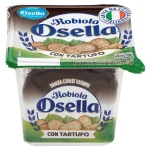
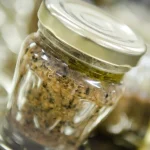
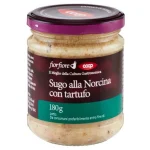
The quantity of truffle in packaged products varies from 0.5% to 2-3% and is treated with flavorings.
The lyophilized aroma trick: uncovering the secret of truffle risottos
Even in packaged products, such as risottos or pasta, another secret is hidden: the use of freeze-dried aroma. In the case of rice, for example, a minimal quantity of truffle (from 0.5% to 2-3%) is added, previously treated with a generous amount of synthetic aroma and then freeze-dried*. This way, an entire 250-gram package can be given the flavor of truffle. The cost for the producer is only a few cents, as low-value summer truffle scraps are used, while the consumer is convinced they are buying an authentic "Truffle Risotto" and is willing to pay a price six to seven times higher than that of plain white rice.
The aroma used derives from certain volatile chemical compounds naturally present in specific products, which impart that precise sensory characteristic to foods. It represents the combination of smell and flavor. When the food industry perceives a weakness in the ingredients used, it intervenes by adding synthetic aromas that integrate the flavor lost during industrial processing. This phenomenon is found in many products available on the market. For example, in the case of strawberries, furaneol is used, for onions, allyl propyl disulfide, and for parsley, apiol.
At this point, it becomes essential to read the label carefully. The wording "product containing aroma" or simply the word "aroma" indicates a substance obtained in a laboratory, while only when "natural truffle aroma" is specified, is it a component extracted from the truffle itself. In recent years, I have noticed a tendency among some restaurateurs to purchase low-quality products for purely decorative purposes, later correcting the taste with a little synthetic flavored oil. Connoisseurs suggest that, when it comes to bis(methylthio)methane, a slight tingle and a persistent, pungent aftertaste can be felt. The Italian Federation of Associated Truffle Growers (FITA) awards a plaque to restaurateurs who exclusively use real truffle in their cooking.
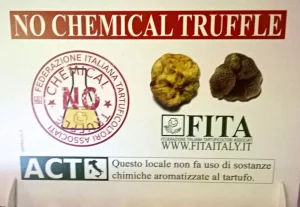
FITA recognizes with a plaque restaurateurs who choose to use exclusively authentic truffle in their cuisine.
In conclusion, the world of truffle risottos and dishes hides a mystery that can deceive even the most expert palates. It is important to be aware of the widespread use of synthetic aromas and the ingenious techniques employed in the food industry to create an illusion of authenticity. Carefully read labels, look for the words "natural truffle aroma," and rely on restaurants that use only real truffle. Only then can you savor the true delicacy of truffle and avoid culinary disappointments. Don't be fooled by imitations: label transparency is your guide to authenticity. Choose wisely and enjoy the unique pleasure of truffle in your favorite dishes.
*Lyophilization or freeze-drying is a technological process that allows the elimination of water from an organic substance with minimal possible deterioration of the structure and components of the substance itself. Wikipedia