
Garda Truffle


A precious fruit of the earth, truffles have been known since ancient times in many areas of Italy.
In the last twenty years, it has been discovered that the Alto Garda Bresciano area is also highly suitable for the growth of this prized and sought-after product. Truffles from the Brescia area grow at altitudes ranging from 80 to 1500 meters, depending on the species.
It is a fungus that, unlike others, grows underground and is therefore called a "hypogeous fungus."
It grows in symbiosis with the roots of specific trees such as poplar, oak, hazel, hornbeam, and lime, and there are various types. The most common in the Brescia Garda area are:
–Tuber melanosporum Vitt. or Black Truffle.
Of excellent quality, it ripens from November to mid-March and grows at altitudes from 70 to 700 meters. (Pictured below)
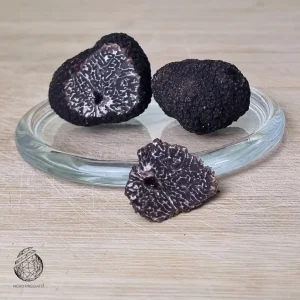
–Tuber aestivum Vitt. (uncinatum form).
Ripens in the summer at an altitude ranging from 400 to 1450 meters.
–Tuber aestivum.
Also ripens in the summer, from late May to August, and grows at altitudes between 80 and 600 meters.
–Tuber macrosporum Vitt. or Smooth Black Truffle.
Ripens from October to December and grows at altitudes from 130 to 950 meters.
Other, less common and known varieties of truffles are also present:
Tuber brumale Vitt., Tuber magnatum Pico or White Truffle, Tuber mesentericum Vitt. or Ordinary Black Truffle.
Various breeds of dogs are used for truffle hunting; even mixed breeds are well-suited. They are trained by associating the search activity with play. The search for this special product is said to be extremely relaxing because it creates a close connection between humans and nature, and with the accompanying dog, a strong bond of complicity is formed.
To go truffle hunting, it is mandatory to hold a specific license and follow the different harvesting calendars, in addition to respecting good rules for nature conservation.
It's important to know that, in addition to being a highly prized ingredient in cooking, truffles are also an important "Environmental Sentinel." In fact, truffles do not tolerate pollution or anything else that could be harmful to nature.
In cooking, truffles are used for their organoleptic properties and to enhance culinary delights. To best bring out their properties, it is advisable not to pair them with foods that have excessively strong and distinct flavors. It is also good to learn, according to the various types, their best use and treatment.
If not consumed immediately, it is best not to wash truffles, but only to clean the soil off them at the time of use. Black truffles are cleaned with a soft-bristled brush under running water and then carefully dried with a soft cloth or paper towel, while white truffles should never be washed, but only cleaned with a brush and a damp cloth. They can be stored for a short period in the refrigerator, making sure to wrap each one individually in paper towel and place them in an airtight container; or they can be frozen after being allowed to dry at room temperature for a few hours, then placed in freezer-safe containers.