
False Black Truffle

Fake Prized Black Truffle: The world of truffles is fascinating and complex, populated by gourmets and enthusiasts who appreciate their unique aroma and flavor. However, it is also a sector where fraud is commonplace, with scammers trying to pass off low-quality products as expensive delicacies. An emblematic example of this practice concerns Tuber indicum, a truffle from Asia, often sold as the more prized Tuber melanosporum, also known as the Prized Black Truffle.
Frauds and counterfeit methods
Tuber indicum, a non-European species, is often illegally imported from China and India and resold in Europe as Tuber melanosporum, but at significantly lower prices. This happens because Tuber indicum almost completely lacks aroma, an essential characteristic for true truffle connoisseurs.
To overcome this lack, fraudsters enclose Tuber indicum in bags along with Tuber melanosporum to allow them to acquire a minimum scent. In restaurants, these truffles are then often seasoned with truffle oil to mask their inferiority.
How to recognize a fake
To avoid falling victim to fraud and buying Tuber indicum passed off as Tuber melanosporum, it is important to pay attention to several characteristics:
- Smell: Tuber indicum has an almost nonexistent smell, while Tuber melanosporum has an intense and characteristic aroma.
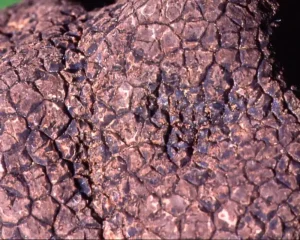
- Peridium: The peridium of Tuber indicum is formed by flat warts, while that of Tuber melanosporum is formed by pyramidal warts.
- Gleba: The gleba is black with white veins, very similar to Tuber melanosporum.
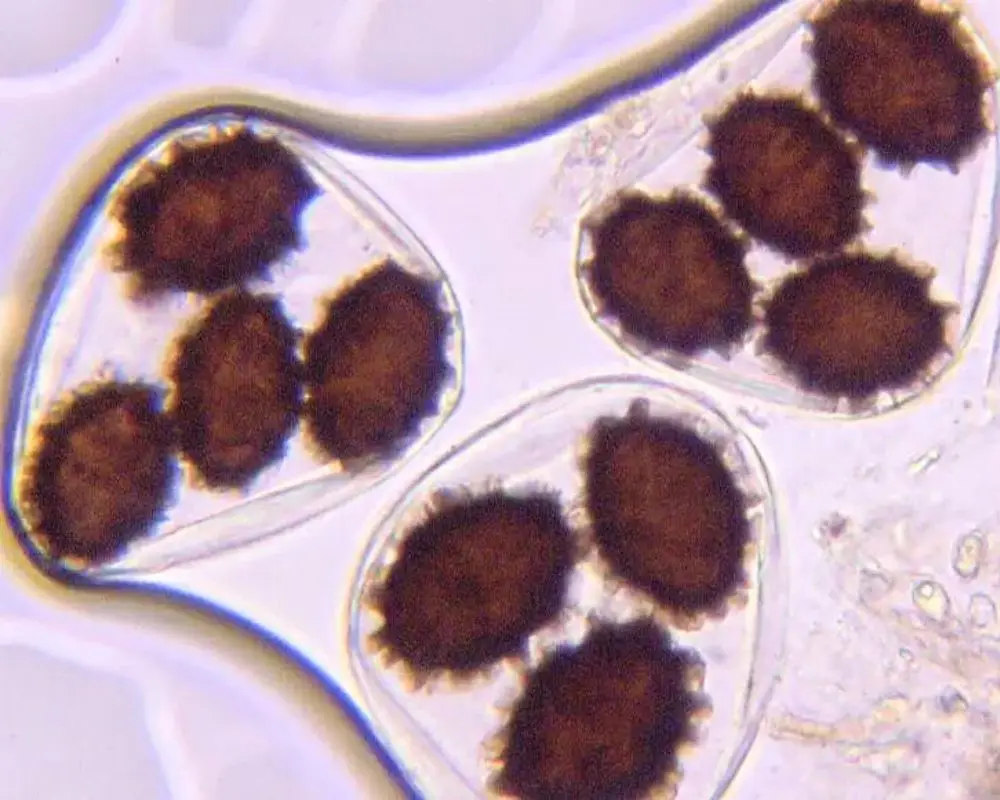
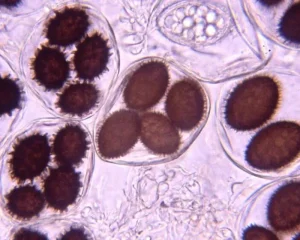
- Microscopy: The spores of Tuber indicum have curved spines gathered in tufts, while those of Tuber melanosporum have straight and isolated spines.
The truffle market is vulnerable to various forms of fraud, but with a thorough understanding of the characteristics of the different types of truffles, it is possible to avoid scams and ensure that authentic products are purchased. The comparison between Tuber indicum and Tuber melanosporum is a clear example of how detailed knowledge can make the difference between an authentic culinary experience and a costly disappointment.
Tuber indicum
Description
Genus: Ruber
Species: indicum Cooke & Massee
Systematic position: Order Pezizales, Family Tuberaceae
Habitat
Tuber indicum, also known as Chinese black truffle or Himalayan black truffle, is native to Asia, particularly the regions of China and India. It grows mainly in mountainous and hilly areas, often associated with mixed forests of oak and pine. The natural habitat of this truffle includes:
- Climate: Prefers temperate and cool climates, typical of higher altitudes in mountainous regions.
- Soil: Thrives in calcareous, well-drained soils rich in organic matter.
- Vegetation: Usually found in symbiosis with the roots of trees such as oaks (Quercus spp.), pines (Pinus spp.), chestnuts (Castanea spp.), and hazelnut trees (Corylus spp.).
These conditions favor the development of Tuber indicum sporocarps, which can be found underground, often a few centimeters deep. Harvesting typically occurs during winter, when the truffles are mature and ready to be dug up.
Description of Sporocarps
The sporocarps of Tuber indicum can reach a diameter of up to 6 cm, presenting a globose-gibbous, tuberiform shape. The peridium, which is not separable, is reddish-brown or brownish-black, consisting of large polygonal, flat plates, 3-4 mm wide, giving it an almost smooth-areolate appearance. The gleba is compact, firm, and blackish, traversed by thin whitish veins. The smell and taste are almost null.
Microscopy:
- Spores: Ellipsoidal, verrucose-aculeate, with curved spines gathered in tufts, up to 4 µm high, measuring 25-30 x 17-19 µm.
- Asci: Sac-like, containing 2 to 4 spores.
Microscopy photo
Fake Prized Black Truffle
Microscopy photo of Tuber indicum spores and asci on the right and Tuber melanosporum on the left for comparison.
Detail of Tuber indicum peridium
Fake Prized Black Truffle
Tuber indicum and Tuber melanosporum compared
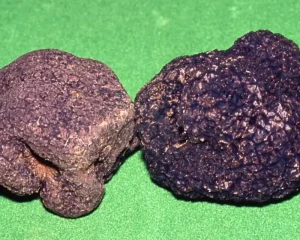
Photo: Pensalfini A.
Bibliographic references: Montecchi A. & Sarasini M “FUNFHI IPOGEI D’EUROPA” 2000.