
Growing truffles on your land


What seemed like a dream thirty years ago is now a tangible reality. But only under certain conditions: time investment managed by Mother Nature, suitable soil for truffle quality, and money for the planting.
Once considered a mystery, an inexplicable wonder, today everything is known about truffles and how they are grown, so much so that cultivating truffles is now possible. You can buy truffle plants, generally trees, which in the long run could provide their fruits, to be found underground like precious treasures.
However, it remains a complex activity, requiring the co-occurrence of a large number of factors to yield results, and therefore is never certain.
How spontaneous ones grow
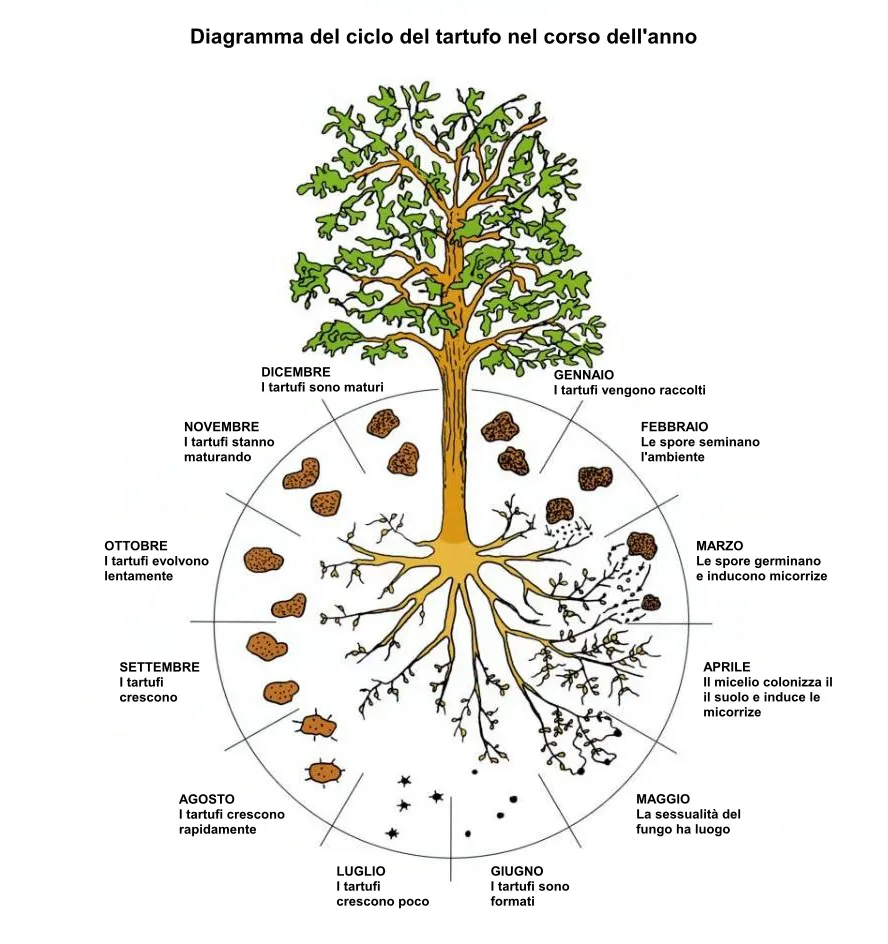
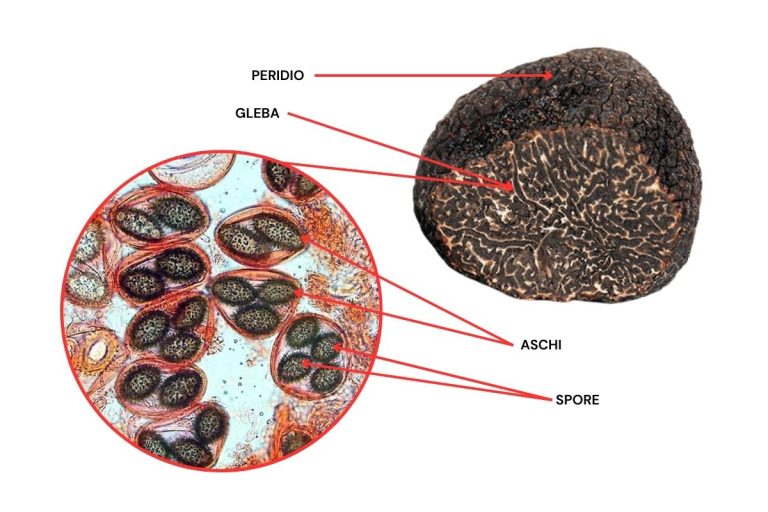
The truffle is a hypogeous fungus, meaning it lives and completes its entire life cycle underground, with a rind, technically called a peridium, and an inner part, called the flesh or gleba, of a different color depending on the species.
The truffle cannot sustain itself but lives in symbiosis with a tree, a bush, or a herbaceous plant, with which it forms a "mycorrhizal symbiosis." How does this symbiosis occur? Mycorrhizae, tubular structures formed by primary elements called hyphae, penetrate the superficial layers of the plant's roots to extract water, mineral salts, and other sap components. In the presence of certain conditions, the aggregate of hyphae (i.e., the mycelium) forms the fruiting body that we call a truffle.
This is not a parasitic behavior because this symbiosis is beneficial to both organisms, which show improved growth.
What is a mycorrhizal plant?
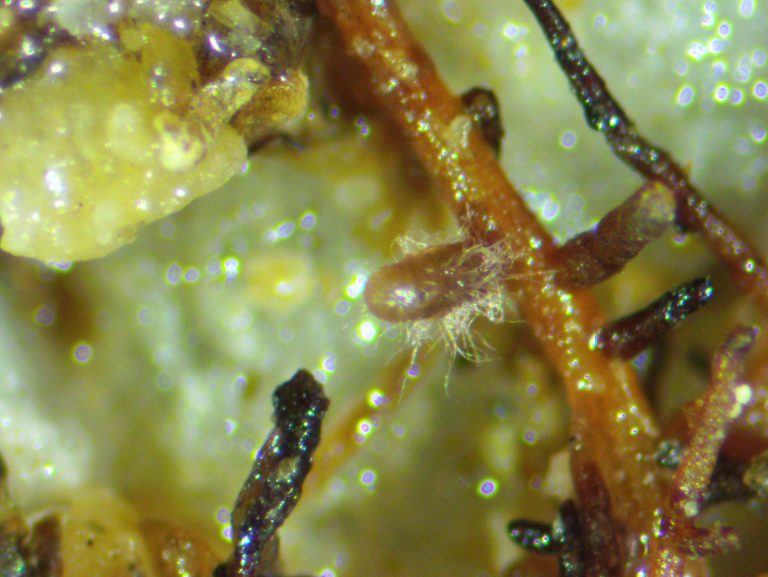
To cultivate truffles today, if the environmental conditions and available land are suitable, mycorrhizal plants can be planted, which, over the years, can lead to the formation of truffles. Mycorrhization means artificially inoculating the hyphae of Tuber, truffle, onto the roots of a plant.
This operation cannot be carried out at home, but only in production centers for mycorrhizal plants, with specific technologies, personnel, and conditions. This justifies the establishment of certified mycorrhizal plant production centers and the cost of individual plants.
Trees and territory

To cultivate truffles with good chances of success, it is very important to identify the tree species that can grow in our environment without problems and the truffle species that combine with both.
From cedars to oaks
The list of plants that live in mycorrhizal symbiosis with truffles is long, and almost all of them can be artificially mycorrhized: cedars and pines among conifers, poplars, willows, and lindens, a series of oaks among broadleaf trees, hazelnuts among fruit trees, hornbeams, and cistus.
WHITE TRUFFLE
It is the most prized, has a less extensive range than the black truffle because its pedoclimatic requirements are higher and often its spread in a given area is patchy with small and localized nuclei. Cultivating white truffles still yields random results and is not recommended except as a supplement to black truffles.
It can only be cultivated in soils that have all these characteristics:
• Medium fertility,
• Sub-alkaline reaction with pH up to 8,
• Fresh, flat, in valley bottoms, along streams and rivers, with annual rainfall exceeding 1000 mm,
• Preferably on North-East or North-West slopes,
• Of marly clay nature.
These characteristics are found in the northern regions and less frequently in the central regions.
BLACK TRUFFLE
In nature, it grows where oaks (holm oak, sessile oak, downy oak, common oak) are found, the trees that most easily enter into symbiosis with truffles of this species, but it is also common to find them in hazelnut and hornbeam woods.
Cultivating black truffles requires soils that are:
• Calcareous in nature and rich in skeletal material (stones),
• With a good supply of potassium,
• Sub-alkaline in reaction,
• Preferably on South, South-East, South-West slopes in the northern and central regions; exposed to North, North-East, North-West in the southern regions of Italy,
• On a slope, to allow for drainage of excess water,
• Between 400 and 1000 meters above sea level
• With sparse herbaceous vegetation under the trees.
"Creating" the forest perfectly

Truffle farming is therefore a highly specialized branch of agriculture, whose objective is to cultivate truffles identical in shape, consistency, taste, aroma, and scent to those of the wild product.
It's not enough to simply buy a mycorrhizal plant, dig a hole, and wait patiently. Here's how to proceed.
The first step, as in all cultivation, is soil preparation:
• In spring: removal of trees and shrubs to reduce competition from other fungal species in the soil,
• In summer: shallow plowing when the soil is "in temper," meaning sufficiently moist to allow the turning of the sod to eliminate spores and mycelia of fungi present in the soil through exposure to air and sun,
• In autumn: harrowing before planting in the second half of autumn.
For each seedling, between two and three years old, a 30 cm diameter hole of the same depth is dug. A layer of gravel is placed at the bottom to ensure good drainage, then the plants are unpotted and handled carefully to maintain the integrity of the root ball (water them thoroughly a few hours before so they don't crumble in your hands) to avoid damaging the root tips where the inoculation was performed and the mycorrhizae developed.
The minimum recommended number for amateur cultivation is at least ten plants, for 600 sq m. The planting distance is 5 x 5 meters using oaks, or even closer with hazelnuts.
Cultural Care
In soils where truffles are cultivated, all types of fertilizers and chemical herbicides are banned. Manually remove weeds that could harm the growing plants, such as brambles and clematis. Control weeds with light hoeing around the trunk, not exceeding a depth of 5 cm.
Irrigate as needed, remembering that the root system is not yet well developed, and mulch the soil to reduce excessive evapotranspiration.
Mulch should be removed before winter arrives.
From the third year, with regular development, begin pruning the lower branches to encourage the plant to develop a single, clean trunk. This will allow good sun exposure of the soil at the base, where future truffles will develop.
Waiting times and certainty of results

The result is so influenced by the pedological and climatic characteristics of the planting site that only in suitable locations or with responsive characteristics can the result be considered certain. To what extent is not known beforehand. Waiting times vary according to the mycorrhizal tree species and its degree of development. Hazelnuts and hornbeams, the fastest, can enter production as early as the sixth year, while oaks, slow in development, take between the eighth and twelfth years.
White, black, winter, summer, and many others…
The most well-known truffles are the white truffle, the most prized and expensive, Tuber magnatum, and the black truffle, T. melanosporum. However, there are others such as the winter truffle, T. brumale, and the muscat truffle which is a variety of it, T. brumale 'moschatume'; the summer truffle, T. aestivum; the uncinatum truffle, T. unicinatum; and the bianchetti, T. albidum.
The white truffle is the most prized
This species has a light yellow peridium, sometimes with greenish tinges, always smooth without warts. The flesh is darker and ranges from hazel to brown with possible bright red hues, which are completely natural and do not indicate product alteration. The pleasant and intense aroma is unmistakable. Among autumn truffles, it is the first to ripen and is harvested from September until the end of the year.
Black, from Central Italy
Widespread throughout Italy, "the international capital of truffles" thanks to dedicated events and attentive gastronomy.
We recognize it by the dark color of its peridium, which ranges from black to brown, rich in minute, warty protuberances.
The flesh, always dark in color, between black and violet, has thin, branched, light veins that turn red upon oxidation and black when cooked.
Generally globose, but also lobed, black truffles vary greatly in size: from that of a hazelnut to that of a tennis ball.
The search, always with a dog
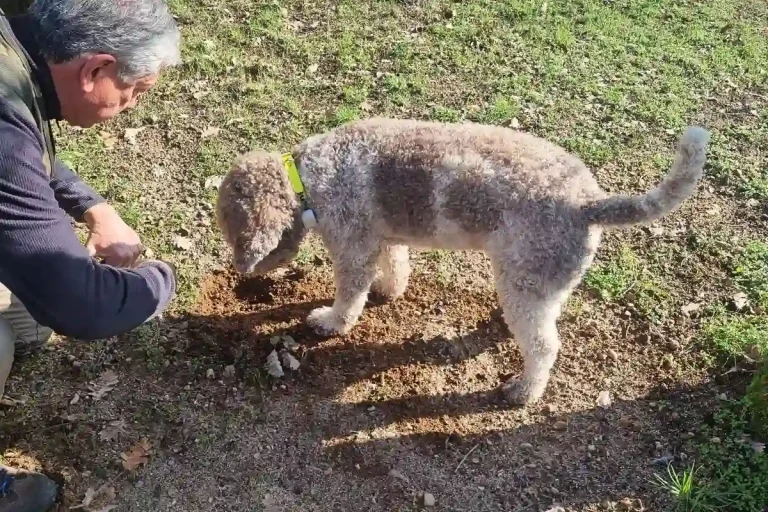
Truffle hunting is a team effort: the precious fungus cannot be found without a truffle dog, usually a Lagotto, trained for this purpose by its owner, with whom a special rapport and refined communication and signals are established. It is difficult, in fact, to go out hunting with a dog that is not your own, that you don't know and doesn't know you.
For truffle hunting in state-owned forests, in addition to a suitable dog, a special permit issued by the regions after a specific course is also required.
In your own woods, however, you and your dog can go freely whenever you wish.
Where to buy truffles?
Today there is a rather extensive commercial network for truffles, ranging from harvesters to online sales, including events, delicatessens, and even large retailers. Among the various qualities of black truffle, it is the most affordable.
This portal aims to offer the best of Precious Black Truffle (T. uber melanosporum) directly to your home.
So that you don't get fooled by merchants and restaurateurs, who today are no longer restaurateurs but merchants…
My 20 years of dedicated work have led to a superb quality of fine black truffle.